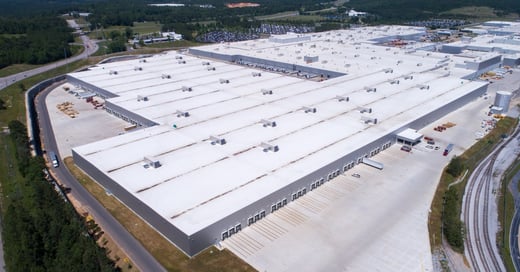
What Causes Commercial Roof Leaks (And Why They’re Rarely Where You Think)
Commercial roof leaks have a way of creating confusion. A water stain shows up on a ceiling tile, a drip appears near a wall, or moisture is discovered during routine maintenance, and the immediate assumption is that the problem exists directly above that spot.
In most cases, it doesn’t.
Commercial roofing systems, especially flat or low-slope roofs, are designed to move water efficiently across large surfaces. When something fails, water often travels, sometimes several feet or more, before it becomes visible inside the building. That disconnect between where the leak shows up and where it actually starts is one of the biggest challenges in diagnosing and repairing commercial roof issues.
At Kavlan Contracting, this is one of the most common scenarios we encounter across commercial and multi-family properties in central Indiana. Understanding where leaks truly originate, and why, is critical to solving the problem correctly the first time.
The Illusion of the Leak Location
Water rarely takes a straight path from the roof to the interior. Once it penetrates the roofing system, it follows the path of least resistance, along insulation layers, decking seams, structural members, and even conduit lines.
By the time moisture reaches the interior, it may be far removed from the original entry point. This is why patching the visible area often fails to solve the issue. The actual problem remains, and the leak returns under the next set of conditions.
In commercial buildings, especially those with large roof spans, this effect is amplified. A leak showing up in one unit or section of the building can originate from a completely different area of the roof system.
Penetrations: The Most Common Failure Point
The majority of commercial roof leaks start at penetrations, areas where something passes through the roofing system. HVAC units, exhaust vents, skylights, and plumbing stacks all require precise sealing and flashing.
These areas are inherently more vulnerable because they interrupt the continuity of the roofing membrane. Over time, movement from thermal expansion, vibration from equipment, and general material fatigue can compromise seals.
Even a minor separation at a penetration can allow water to enter slowly. And because these areas are often surrounded by equipment, they can be difficult to inspect thoroughly without experience.
In many cases, the roofing membrane itself is still intact, it’s the detailing around these penetrations that has failed.
Seams and Membrane Failures
Commercial roofing systems like TPO, EPDM, and modified bitumen rely heavily on seams. These seams are either heat-welded, adhered, or mechanically fastened, depending on the system.
When seams begin to separate or weaken, they create entry points for water that are often invisible from a distance. Unlike punctures or tears, seam failures can be subtle, especially in early stages.
Temperature fluctuations, UV exposure, and installation quality all play a role in seam performance. In Indiana’s climate, repeated expansion and contraction cycles accelerate this process.
Once water enters through a seam, it can spread laterally across insulation layers, making it difficult to pinpoint without a systematic evaluation.
Drainage Problems and Ponding Water
Flat roofs are designed to move water, not hold it. When drainage systems aren’t functioning properly, water begins to pond, and that’s where problems develop.
Ponding water increases pressure on the roofing membrane and exploits any existing weaknesses. Over time, it accelerates material breakdown, especially at seams and transitions.
Clogged drains, poor slope design, and sagging sections of the roof can all contribute to this issue. In commercial properties, even minor drainage inefficiencies can lead to significant long-term damage because of the volume of water involved.
The longer water sits on a roof, the more likely it is to find a way in.
Flashing and Transition Failures
Anywhere the roof meets a vertical surface, parapet walls, curbs, or adjoining structures, relies on flashing to keep water out. These transitions are some of the most critical and most failure-prone areas in a commercial roofing system.
Flashing materials are constantly exposed to movement, temperature changes, and environmental stress. Over time, they can separate, crack, or lose adhesion.
When flashing fails, water doesn’t necessarily pour into the building. Instead, it often enters behind the membrane or into wall assemblies, where it travels before becoming visible.
These types of failures are frequently misdiagnosed because the symptoms don’t align with the source.
Why Commercial Leaks Are Often Misdiagnosed
The complexity of commercial roofing systems makes leak detection more challenging than most people expect. Multiple layers, large surface areas, and interconnected components all contribute to the difficulty.
Quick fixes, such as applying sealant to a visible problem area, may stop water temporarily, but they rarely address the root cause. Without identifying where water is entering the system, repairs become reactive rather than effective.
This is why experience matters. Diagnosing a commercial roof leak isn’t about finding where water shows up, it’s about understanding how water moves through the system and tracing it back to its origin.
The Cost of Getting It Wrong
Misdiagnosing a commercial roof leak doesn’t just lead to repeat repair, it can escalate into broader issues. Moisture trapped within insulation reduces its effectiveness, increases energy costs, and can lead to mold growth or structural deterioration.
For businesses and property managers, this can also mean operational disruptions, tenant complaints, and potential liability concerns.
Addressing the problem correctly the first time isn’t just about the roof, it’s about protecting the building as a whole.
A Systems Approach to Commercial Roofing
Commercial roofs aren’t just surfaces, they’re systems. Membranes, seams, penetrations, drainage, and structural components all work together. When one part fails, it affects the performance of everything around it.
At Kavlan Contracting, our approach focuses on identifying how and why a failure occurred, not just where it appears. That allows us to provide solutions that last, rather than temporary patches that need to be revisited.
This kind of evaluation is especially important for properties that have experienced recurring leaks or multiple repair attempts without long-term success.
Get Clarity Before the Problem Spreads
If you’re dealing with a commercial roof leak, or even just signs of moisture, it’s worth taking a closer look before the issue grows. The earlier the source is identified, the more controlled and cost-effective the solution becomes.
Contact Kavlan Contracting today to schedule a commercial roof evaluation and get a clear understanding of what’s actually happening, not just where the symptoms are showing up